embedded by Embedded Video
Analysis



Over-arm bowling Part II video :
Bend elbow: especially while bowling doosra.
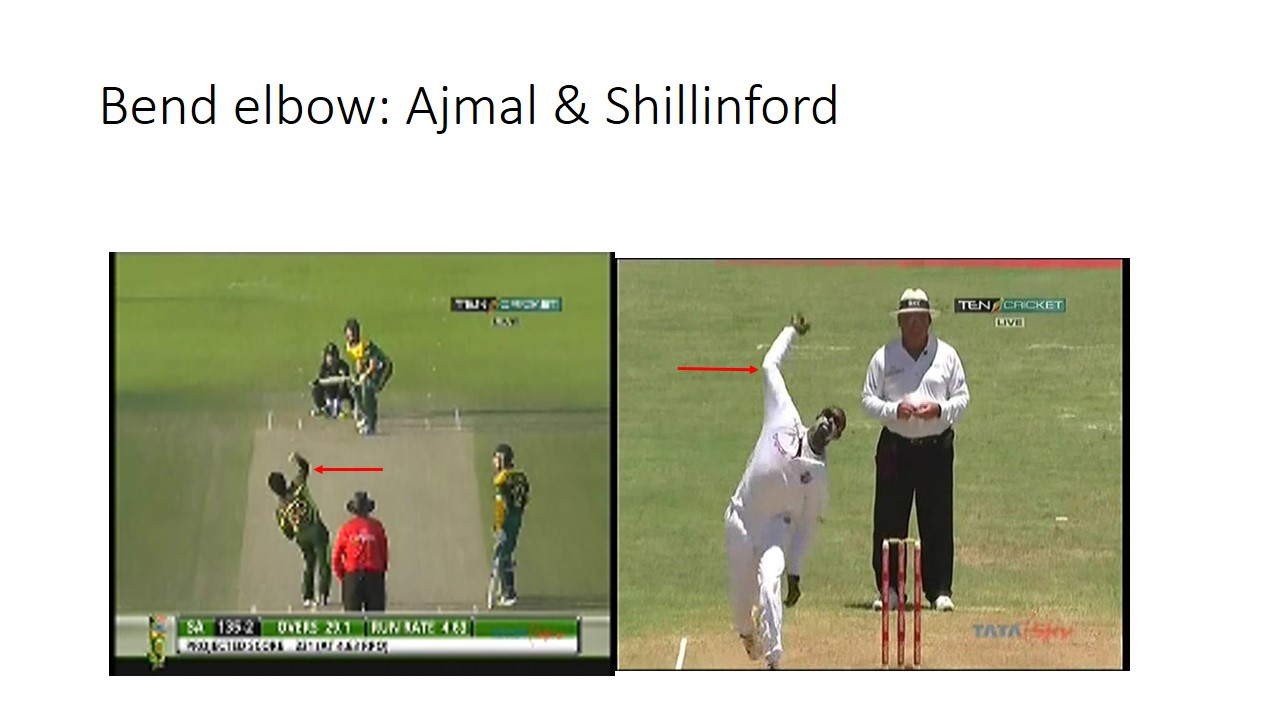
Bend Elbow

embedded by Embedded Video
Over-arm Bowling – unlike batting, this involves 4 skills viz. 2 primary & 2 secondary Primary skills – 1) Length – is the foremost skill one learns as a bowler. 2) Line – of the ball. … Continue reading
‘Technique’ is the most hyped & emphasised jargon used in the cricketing world. To understand technique, one has to know the grammar of cricket.., in batting, bowling and fielding Grammar is very important, I feel, since technique can always be tweaked for adapting to situations.But grammar …no. Grammar is similar to the laws of nature. For instance people do not walk backwards, or one cannot sit and bat, or that you do not apply sweat on rubber/tennis ball for it to swing!.
And Technique should be related to scoring runs, because in reality scoring runs and not the technique, should be the paramount concern for a batsman.
There are only two ways a batsman can bat viz. with a vertical bat & with a horizontal bat.
Let’s start with batting From the inception of cricket, short-straight in line-high- bounce deliveries were always difficult to score off. In fact more than 50% of the batsmen would get out to this kind of a delivery. And if not, they would be scared and would sway away, to avoid getting hit. I reckon this technique still remains the favourite amongst fast bowlers provided it exceeds a certain height and speed. Otherwise it becomes a liability for them and their team.
However, batsmen in the last few years have found a new technique to score runs (not necessarily to counter this kind of a delivery) viz. the slap shot. Either the flourishing format of T20 games, childhood inheritance or the inability to score runs by playing conventional shots could have been responsible for this A cross batted swat/slap shot: – a few years ago this technique was considered to be incorrect by some experts. But now it has become a beautiful jargon for them, since it is consistently fetching runs …in plenty.
According to me, the do’s of the batsmen are :
* Improvising their technique to help them score runs in all conditions, against all types of bowling, and not to help defend their wicket. However it is the pressure created by a situation that makes a player weak or strong, and their inability to control the situation leads to their downfall.
* Improvising their technique to return to form if they lose it. This can be done either by watching other players (similar to him either in technique or in temperament) live in action or in videos, or watching his own videos, or watching himself in the mirror while playing. In the last scenario, a coach or an assistant should be there to monitor his technique.
* Trying to find common patterns and imbibing them while watching other players play. The idea is not to replicate them.
Technique is the most hyped and emphasised jargon used in world cricket…..
And the reason for this might be the length of the game (too long, and too slow) or – at any given moment there are three different cricket skills viz. batting, bowling, fielding, employed by three different players play and they all have to synchronise to produce results. This can be done without scoring a run or getting a wicket.
I personally feel when these 3 skills merge together then technique becomes the primary object of discussion by everyone, as they are pitted against each other every time. Sometimes it’s strange when a bad ball gets a wicket due to a bad shot played, or a good shot played and the fielding is excellent. Also good balls go for a boundary.
If closely observed, every player changes his technique over a period of time, and lately they have been doing in the midst of their innings. At most times its so subtle that they are not aware of it. Therefore any player, from any country, playing in any condition and any situation, can have his own technique provided he is consistently successful in its execution. Which is why change is bound to happen. We are humans, not machines, and there are various factors that lead us to change, automatically.
However he needs to find out what has helped him to succeed while playing. Sometimes it’s not easy. Hence he needs to alter a few things, try out new things, which would help him to find the problem and the solution to it. If he doesn’t try, then he won’t know. Therefore decision making becomes paramount. And once his decision produces the result (success or failure), then he becomes confident to understand whether or not to apply that skill. He would also know what is good for him for that moment and how to employ a particular skill at a given time. This confidence is the key for him to move on.
Now, going back to the type of shots a batsman can play viz. vertical & horizontal bat shots.
Top hand is his guiding hand, or the radar-hand, and the bottom hand is the power hand. With the help of supple wrists, a batsman can be more effective in playing either horizontal or vertical shot. In cricket, unlike some other sports. both hands and feet are used simultaneously.
For instance, in badminton, where though the shuttlecocks are light, it is almost impossible to play with both hands or take turns to play with either hand. Why do you think so ? Because though the shuttlecock goes up fast it comes down slowly. And since the length of play court is only 13 meters, it is never easy to play with both hands. In tennis, the play court is longer, and instead of the shuttlecock, there is this soft tennis ball which travels faster. The racquet is big and powerful. Still most players use both their hands to full effect and success.
I wonder if these racquet sports’ techniques can be used in cricket to deal with the short-vertical-fast-bouncy-ball !
A quick look at the table below shows on which type of deliveries the horizontal or the vertical shots can be played. It is interesting to note here that the vertical shots cannot be played to a high rising ball.
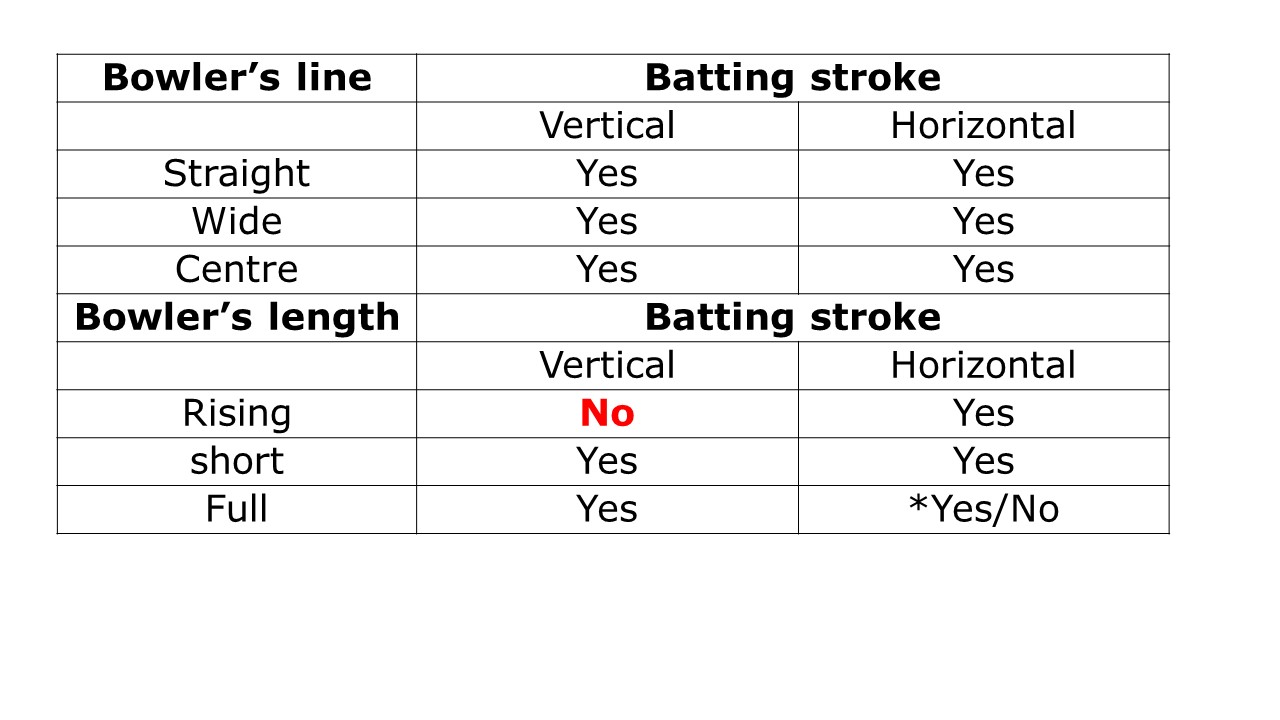
*Please also note that it is not possible for a batsman to play a defensive shot with a horizontal bat (unless it is ‘blind cricket’)
If a batsman can anticipate short pitch deliveries coming towards him, and is able to move away and play horizontal shots, then it can be dealt with. But how does one practice without knowing when a bowler will pitch it short or full, slow or fast ?
The answer to this could be as follows :
1- If a batsman stands with a high back lift (a la Gooch), his chances of playing either vertical or horizontal shots is greater, than if his bat is grounded. This is because the bat is lighter when it is not grounded. (but please note that the top hand needs more control to guide the ball. Hence the grip needs to be firmer when guiding)
2- A batsman should stand open-chested (2 eyed stance) with his back leg covering almost the middle-off stump, and the front leg wide outside leg stump. This is how Kepler Wessels used to stand (But beware of the gap between the legs, since this allows the bowlers to bowl in-swingers & Yorkers)
3- Hand Power: Strong hands with supple wrists are important here. Like the drummers in bands who play the drum solo with great flexibility and speed without banging the drum plates. Also badminton players who use their wrists very late to guide the shuttle.
4- Balance of the feet – The way the racquet sports players allow their body to be in a position to play either vertical or horizontal shots or leave them is amazing. In cricket, I am not sure if the umpire will allow a batsman to move constantly like the racquet players do. But if they allow, then the batsmen need to move like them, and balance themselves to apply complete power to play horizontal shots.
However the fact of the matter is every batsman on this planet was and is conditioned to bat with a conventional stance & a still position
The 4 techniques mentioned above have definitely helped the current batsmen to perform better, as can be seen in the few examples below. These batsmen have great control over the vertical and horizontal shots and it doesn’t matter which format they excel in……..only scoring runs matter, irrespective whether it is in TEST, ODI or T20.
A batsman can only play with a vertical bat & with a horizontal bat!.


Here are a few examples of batsmen who have great control over the vertical and horizontal shots –
In recent times ‘slap cover drive’ has become a regular method with a lot of batsmen, David Warner is one of them. In past even Ricky Ponting uses, though with a vertical bat which looked very conventional to naked eye…
* Roelof van der Merwe – He was the first batsman I saw who effectively played the “slap shots”, dangerously, but successfully (in IPL 2009). As i distinctly remember Morne Morkel (Rajasthan)’s one spell getting “mashed” by Van der Merwe, as he played those gruesome shots over point boundary with his head turned to the leg side. This ordeal continued repeatedly in that IPL!!.
* Tilakratne Dilshan – Plays the “scoop” shot regularly, going on knee and slapping the ball over keeper’s head, and has been employing it in all type of pitches.
* Darren Sammy – He has the unique ability to move across the crease to play big shots. He doesn’t shuffle before the ball is bowled. His feet move like those of tennis players, as he goes deep inside and across the crease to good length balls to slap them over long on or midwicket. Whenever he plays these shots, it appears that he “lift-drag” these balls over the ropes. The bouncers are treated with horizontal jabs, similarly to tennis players, he stands tall with legs apart, and slaps flat batted. So far he has been very successful in suitable conditions, and he hardly miscues, or mis-times any of his power hits.
His style of batting is the most effective way to attack bouncers, and so far he has been very successful. We would see more of this kind of batting next month in England where pitches would be much livelier than Sammy has ever played in his short Test career.
*Virendra Sehwag: Master of vertical shots. His ability to move away from the ball, and yet time and place them where he wants signifies his class as an top class batsman.
* Dwayne Bravo – I haven’t seen any batsman who plays everything vertically except the pull and the hook shot, which is not a regular technique used by him. And like David Warner, he doesnt play a sweep shot.
* David Warner – A fine example of a player who plays the horizontal slap shots very successfully. Phil Hughes is another player who plays this shot, but with less consistency. A drive shot from Warner is less vertical, and more horizontal, since they powered by his bottom hand. This suggests that there is a gap between his bat and his body allowing him more space to play. Yet he’s hardly been out L B W or BOWLED…which is quite interesting, considering he is a left-handed opener, who generally are prone to these kind of dismissals. For that matter even Phil Hughes has had less of these dismissals. As mentioned earlier, we haven’t seen David Warner play a sweep shot.
* Shane Watson – The only batsman in recent times who has the ability to change his technique in the middle of his innings with great success. To me, it seems that he is doing this to merely score runs and not stay at the crease. Lately he has developed a unique way of playing an on-drive. Its more of a “slap straight on-drives” and its very eye catching.
An on-drive is the most precious skill in batting, and the most difficult shot for a batsman to master.
Watson’s uniqueness comes from his bottom hand, which guides the ball very late, as he comes over the ball with a straight bat and places between the umpire and the non-striker. The late adjustment of his wrists enables him to guide the ball straight, not always along the ground but always in gap. It appears that his approach to batting is only to seek runs.
In the past, batsmen like Graham Gooch changed their batting stance, so that they could be more consistent. Gooch employed this high back lift technique, which helped him score faster. And big scores followed consistently, on all surfaces. His statistics showed that more runs were scored with this high back lift technique.
Then there were batsmen like Kepler Wessels, Jack Russell, Jimmy Adams, & Chanderpaul(current) who approached their batting with a very unique batting stance. But this uniqueness was to safe guard their wicket, and not to necessary to score fast or more runs !. Some players in the past had weird techniques, and it helped them do the basics, rather than play aggressively.
Finally I am of the view that batsmen should add these different skills for attacking, not losing their basic skills in the bargain. They should keep on improving these new skills so much so that it becomes a part of their regular skill set. For a batsman, technique is to score runs for his team & himself, and not defend his wicket.
To add to this argument, here is a link to an article sent by my brother, which explains the time it takes for a batsman to play horizontal and vertical shots.
http://www.economist.com/
I found a very interesting sub-link in this article –
http://www.nature.com/neuro/
This is about the visual-motor system, according to neuroscience. I hope the above 2 articles help coaches train the batsmen in handling quality fast vertical deliveries. I also believe that regular practice and simulation will be of great help.
Here is a link to video of how to play H V shots.
http://youtu.be/TZ3eWR9fvSM
embedded by Embedded Video
Run- outs(How to reduce them)
Running between wickets is important, so is the speed in which they run. But these are not as important as ‘quick decision-making’. The decision to take or not take a run
Here hesitancy is always the culprit, leading to confusion and finally …run-outs
To reduce this, players need to understand each other well.
Hence, during training, players need to practice in pairs. This enables them to understand each other well when they run between wickets, thereby reducing run-outs drastically
Hence, in training if players can practice together in various set of pair, than understanding of running between wickets becomes stronger, and run-outs can be reduced to larger extend.
In a cricket team, openers usually have a better understanding of each other for the following reasons :
1- They know in advance that they have to bat together. This gives them more time to understand each other.
2- The initial period (first 5 overs of a test match) of an innings enables them to find out about each other’s strengths & weaknesses while taking runs.
1- 3- The pace of an innings is set by them. Constant rotation of the strike is a major factor for teams to set the trend early in the innings, especially in a Test match. It also allows the players, who follow, to bat comfortably.
If batsman have better understanding than 18% (all formats dismissals)can be reduced.
Here is a video explaining the importance of magic eye and why left-handers are suspect to right- arm bowlers bowling round the wicket.
So far 22 Test matches have been played at end of of 1st Test (Pak v SL)Oct (18-22)2011.
There have been 124 “L B W” dismissals for bowlers, which constitutes 17.61% of total wickets(704 wickets). It’s the second most regular dismissals after wicket-keeper’s catch(20.31%)
Yet, this is the most sought out & satisfying dismissals for every bowler, as it defines/epitomize his accuracy!.
Out of 124 L B W victims, 70(56.45%) were dismissed for low scores(10 or less score), & 50(40.32%) were left-handers.
Here is a absolute look at L B W dismissals in Test matches played in 2011.
A – List of L B W dismissals for right hand & left hand batsmen by various bowlers.
| Type of Bowlers | Left hand batsman | Right hand batsman | Total |
| Right arm pace | 20 | 40 | 60 |
| Off spinners | 17 | 12 | 29 |
| Left arm pace | 11 | 1 | 12 |
| Slow left arm spin | 1 | 15 | 16 |
| Leg break spin | 1 | 6 | 7 |
| Total | 50 | 74 | 124 |
B- List of batsmen dismissed L B W for low score (10 or less).
| Type of Bowlers | Left hand batsman | Right hand batsman | Total |
| Right arm pace | 11 | 25 | 36 |
| Off spinners | 9 | 7 | 16 |
| Left arm pace | 6 | 0 | 6 |
| Slow left arm spin | 1 | 6 | 7 |
| leg break Spin | 1 | 4 | 5 |
| Total | 28 | 42 | 70 |
All data processed at end of 2nd ODI Aus -SA (23rd Oct 2011
embedded by Embedded Video
Contribution and value of a left hander.

In the ongoing(Oct 2011) International cricket, currently every Test playing nation is involved in playing cricket. Below is list of left-handers taking part in these series. The total number of players includes sum of both teams.
| Series | Games | Right-hand batsman | Left-hand batsman | Total Players |
| Australia in South Africa | 4 | 20 | 14 | 34 |
| Eng in India | 4 | 18 | 7 | 25 |
| New Zealand in Zimbabwe | 4 | 26 | 4 | 30 |
| Sri Lanka in Pakistan(UAE) | 1 | 15 | 7 | 22 |
| West Indies in Bangladesh | 4 | 24 | 12 | 36 |
| 17 | 103 | 44 | 147 |
All data processed at end of 2nd ODI Aus -SA (23rd Oct 2011)
What is a new ball mantra?. To compel batsman play every delivery!.
An opening batsman is responsible for building team’s platform, and at the start of an innings he is not aware how the pitch will behave, and how much the ball will swing. Adding to this, he is unaware of what tactics fielding side will employ, and how their opening bowlers will execute them.
Hence most opening batsmen will take some time to settle down. The time period is marginal, depending on different formats of game, adding pitch condition, and also character of a player.
So it becomes important for an opening bowler to make the best use of new ball, and make him play each delivery. If things are not going in his favor, and has tried all his tricks, he still needs to continue doing what he is doing, because even though a batsman will look comfortable, nevertheless forced to solve one problem after another at the start of an innings, which reduces the success rate of scoring runs, and increases possibility of a wicket.
embedded by Embedded Video
List of bowlers opening the innings.
For India
| 2010 | Inns | Wkts | Avg | R/o | St.Rate | Ler x Lsr |
| Ishant | 25 | 56 | 29.39 | 3.59 | 29.39 | 105.79 |
| Zaheer | 20 | 53 | 22.52 | 3.22 | 42.34 | 136.30 |
| Praveen | 11 | 27 | 25.59 | 2.58 | 59.40 | 153.56 |
| Sreesanth | 15 | 18 | 58 | 3.91 | 89.40 | 349.49 |
| Mithun | 6 | 6 | 62 | 4.04 | 92.00 | 368.00 |
List of bowlers opening the innings.
For all countries
| Player | Inns | Wkts | Avg | St.Rate | R/o | Ler x Lsr |
| J Anderson | 34 | 86 | 23.36 | 49.75 | 2.81 | 140.16 |
| D Steyn | 21 | 62 | 21.43 | 40.36 | 3.18 | 128.61 |
| I Sharma | 25 | 56 | 29.39 | 49.12 | 3.58 | 176.35 |
| Z Khan | 20 | 53 | 22.71 | 42.46 | 3.20 | 136.30 |
| M Morkel | 22 | 52 | 25.21 | 49.75 | 3.04 | 151.26 |
| S Broad | 25 | 41 | 30.22 | 61.65 | 2.94 | 181.31 |
| M Amir | 13 | 33 | 22.33 | 45.72 | 2.93 | 134 |
| M Asif | 15 | 33 | 27.36 | 55.10 | 2.97 | 164.18 |
| D Bollinger | 15 | 30 | 27.16 | 47.5 | 3.43 | 163 |
| C Tremlett | 12 | 29 | 25.62 | 49.09 | 3.13 | 153.72 |
A look at India’s opening bowling spell during the ongoing Pataudi series.
1st Test Match, England(1st Innings)
Zaheer Khan and Praveen Kumar opened the bowling, and their spell lasted 14overs(84 balls). England were 23-1. Below is how English openers batted those 14overs.
| Strauss | Indictors | Cook |
| 8 | Runs | 12 |
| 46 | Balls faced | 36 |
| 5 | Singles | 1 |
| 1 | Boundaries | 1 |
| 6 | Maidens | 6 |
| 7 | Scoring shots | 5 |
England(2nd Innings)
Due to injury to Zaheer Khan, Praveen Kumar & Ishant Sharma opened the bowling for India, and their spell lasted 16overs(96balls). England were 34-1. Below is how English openers started their reply after taking a lead of 188runs.
| Strauss | Indictors | Cook |
| 23 | Runs | 1 |
| 52 | Balls faced | 27 |
| 4 | Singles | 1 |
| 3 | Boundaries | 0 |
| 3 | Maidens | 3 |
| 11 | Scoring shots | 1 |
2nd Test Match, England(1st Innings)
Once again India chose to field after winning the toss, and they opened the bowling with Praveen Kumar and Ishant Sharma. Their spell lasted 10overs (60 balls), and England were struggling at 18-1. Below is how it all started.
| Strauss | Indictors | Cook |
| 8 | Runs | 2 |
| 30 | Balls faced | 16 |
| 2 | Singles | 2 |
| 1 | Boundaries | 1 |
| 3 | Maidens | 3 |
| 4 | Scoring shots | 2 |
England(2nd Innings)
India were ahead when England batted again, taking a lead of 67Runs. Once again they opened the bowling with Praveen Kumar and Ishant Sharma, but this they had a short spell of 6overs(36balls). England were 16-1.
| Strauss | Indictors | Cook |
| 3 | Runs | 5 |
| 20 | Balls faced | 11 |
| 3 | Singles | 1 |
| 0 | Boundaries | 1 |
| 2 | Maidens | 0 |
| 3 | Scoring shots | 2 |
3rd Test Match, England(1st Innings)
India batted first, and were bundled out for 224, and made a change to their bowling line up. They employed Sreesanth to open the bowling with Praveen Kumar. Their spell lasted 7overs.
England were comfortably placed at 24-0 after 7overs.
| Strauss | Indictors | Cook |
| 19 | Runs | 5 |
| 24 | Balls faced | 18 |
| 0 | Singles | 1 |
| 4 | Boundaries | 0 |
| 3 | Maidens | 3 |
| 7 | Scoring shots | 3 |
Data processed from Jan 2010 till end of England(1st Inn) 3rd Test, Aug 2011.
Indian players should play like athletes, and play like a cricketers, not look for personal glory, and milestones achievers should not be encouraged by their captain. Team India should now take this series as a 2-Test battle, with no draw … Continue reading
Trent Bridge Review
embedded by Embedded Video
This season in English County, every 2nd game teams manage to score 400!.
18 Teams play 138 games in Two Division in English County.
This season, at the end of 88 games, 54 times teams manage to go past the 400 score, which is about every second game a total of 400 is scored by a Team.
An excellent opportunity for Indian Team!!
…….neverthless 22 times teams were forced to follow-on, which works up to 25%, not a good sign for Indians.
Major Partnership density is in middle order (56 %)
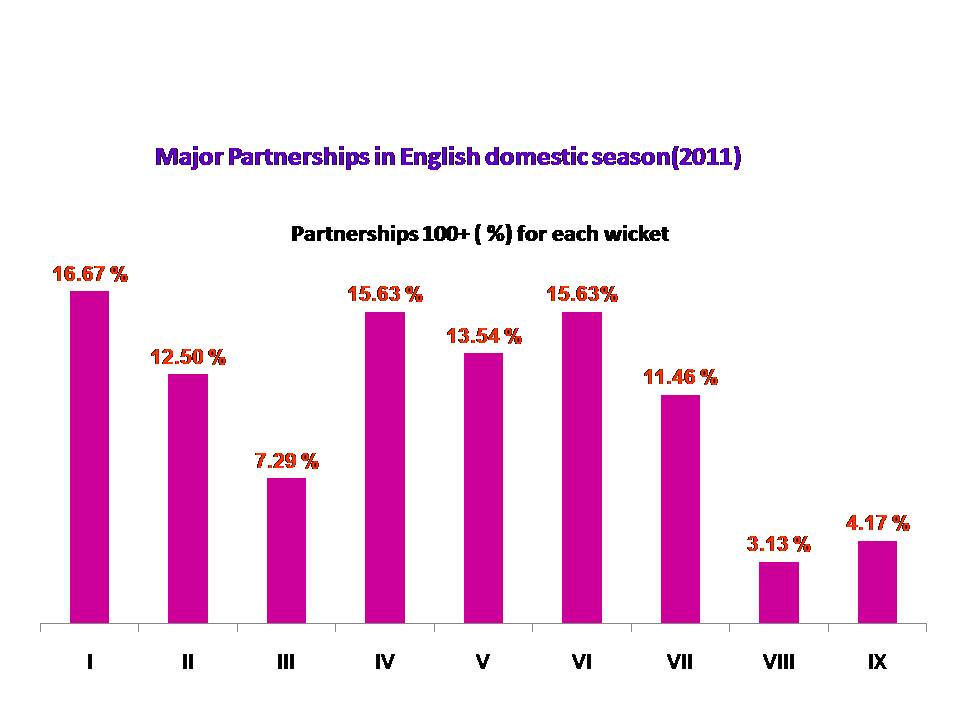
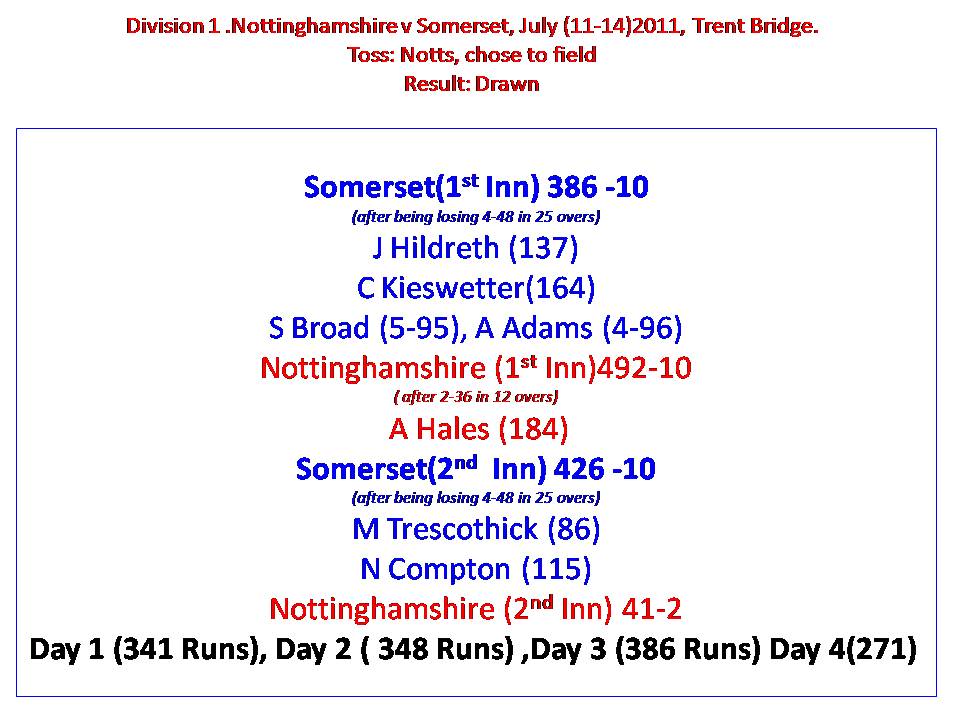
Earlier in July, game between Nottinghamshire v Somerset could be a confidence factor for India!.
What is a job of a top order batsman when he is batting with lower order/tail?.
1- If they are batting first, then look to score as many runs as possible with a better strike rate.
2- If they are replying a 1st Inning score, then make sure they come as close as possible(after avoiding follow on) to that score, by building partnerships with tail, and have a strike rate at which his partner(lower/tail) is comfortable with (some tail-enders like to be scoreless and stick around as long as they can, some like to hit boundaries every second ball).
Neverthless Rahul Dravid’s innings had value in terms of personal landmark, and averting follow on, but could he along with lower order posted substantial partnerships, and come much closer to England’s 1st inn score ?.
Lately Dravid has been involved with lower order partnerships, yet India couldn’t reach 400 or even 300, so is it possible for him to change his batting style, and bat faster ?
If that happens, then partnerships can be build.
Here one is not suggesting 50 or 100 runs, but partnerships of 30s,/40s can be substantial runs for teams.
India’s current line-up is blessed with excellent lower order strikers, and they have enough experience batting with top batsmen.
Here one feels Dravid should change his batting style, and once that happens, the fielding side will become defensive, and instead of attacking to pick wickets, they would try and stop runs, which will allow Dravid to build partnerships with lower order, and India can score decent total consistently.
Here is a look at Dravid’s involvement in partnerships with lower order batsmen in Test cricket.
Rahul Dravid’s Partnerships with lower order batsmen(All Tests)
| Stand | Inns | Runs | 50+ | 100+ | Avg |
| 6th Wkt | 42 | 1855 | 12 | 3 | 46.38 |
| 7th Wkt | 29 | 638 | 3 | 0 | 22.79 |
| 8th Wkt | 20 | 578 | 1 | 2 | 30.42 |
| 9th Wkt | 15 | 371 | 4 | 24.73 | |
| 10th Wkt | 8 | 37 | 4.63 |
Now, if one has to sum up all these partnerships (add all lower order partnerships), then Dravid’s involvement with tail fetched India @23 Runs/Wkt.
… If one has to compare this analysis with Ricky Ponting, his contemporary Test No .3 batsman, then his involvement with tail has fetched Australia 42 Runs/Wkt.
Ricky Ponting’s Partnerships with lower order batsmen (Batting Position No.3,since 2001)
| Stand | Inns | Runs | 50+ | 100+ | Avg |
| 6th Wkt | 34 | 1354 | 9 | 2 | 43.68 |
| 7th Wkt | 22 | 585 | 2 | 1 | 29.25 |
| 8th Wkt | 14 | 636 | 5 | 1 | 48.92 |
| 9th Wkt | 8 | 60 | 7.50 | ||
| 10th Wkt | 5 | 51 | 10.20 |
They both have different batting style, and there is nothing much in terms of average (unless one can measure strike rate of each partnerships) neverthless Dravid can take a leaf from this Aussie.
embedded by Embedded Video
embedded by Embedded Video
In cricket, a team’s platform has to be build by openers so that they along with middle order can produce a total, which will give enough opportunity for their bowlers to defend and win games in all format of cricket.
Team’s 50% (and more) of winning depends on their openers.
In openers category, one also should include opening bowling pair, as they are Fielding Team’s Openers!.

Test Centuries in Bat.Order
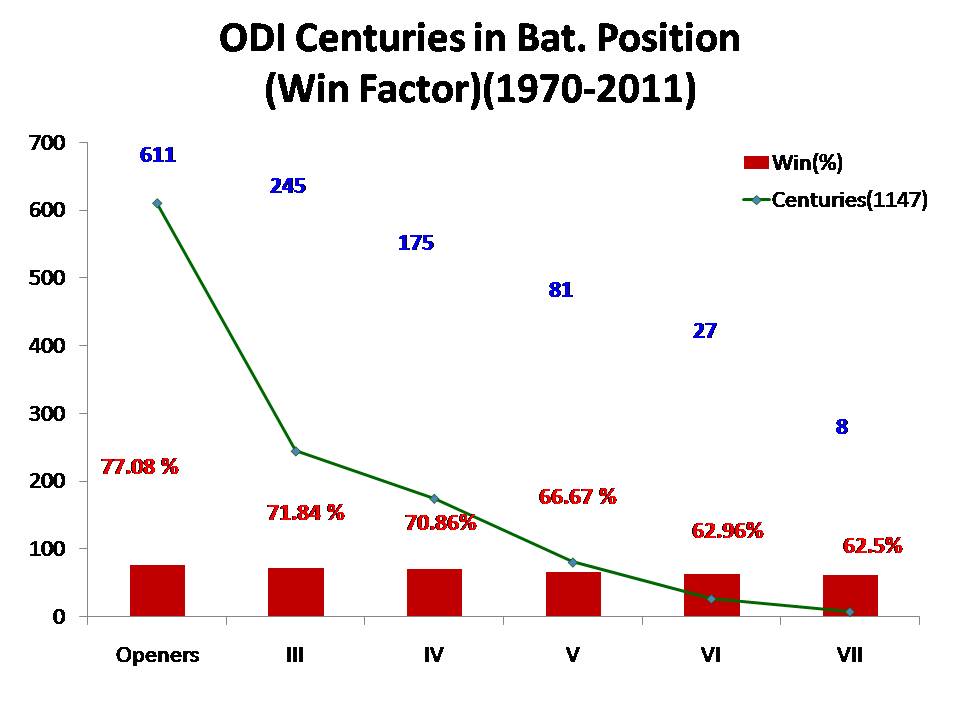
ODI Centuries in Bat.Order

Bowler's 5 Wicket haul in a Test Inning.

Bowler's 4 Wicket haul in an ODI match.
embedded by Embedded Video