30 Jun 2011 Last updated at 3:29 pmScoring Shots & Scoring Rate(The Most accurate indicator in a cricket match).


Scoring Shot : A Run scored from Single Ball of a Bat.

They are 1s, 2s, 3s, 4s, 6s , & any added runs acquired from overthrows. Extras are not added to Batsman’s scoring shot.


Scoring Rate : Balls divided by number Scoring Shots.

In this a Batsman’s hits are counted and not the value of that shot, and they are classified by 1s, 2s, 4s, 6s & so on.

Here we can find out a Batsman’s capacity to score Runs, and how his team is moving along.

On the other side we can also find how much a Bowler is conceding, and after how many balls.  Same theory can be applied for Team’s Progression.


Scoring Rate in Singles & Boundaries

If we classify these Scoring Shots into Singles, and Boundaries we would know how the Team and their Batsmen are moving along these Scoring Shots, & their speed(less balls per scoring shot).

We can also find Fielding Team’s Progression, and identify if their Defense is getting stronger(more balls per scoring shot), and when, or is it getting weaker, and all this can be found out in any selected period of a match.

All this can be done by counting number of scoring shots in an over, and see its development in every over of an inning.

In short, from Scoring Shots, one can find the Progression of both Teams(Bat /Bowl) in any period of time, and give us a fair understanding of where teams have reached in achieving their respective goals in that match.


This is the most accurate indicator in a Cricket match.


Example for Calculating Scoring Rate Formula:

M.Slater 1st Inn vs Pakistan @ Rawalpindi, 1st October, 1998.

Runs 108, Balls 236, Scoring Shots 60(1s x 38, 2s x 10, 4s x 11, 6s x 1)


FORMULA

Balls per Scoring Shot : 236 / 60 = 3.93

Scoring Rate per 100 balls : 60 / 236 = 25.42

Singles per 100 balls : 38 / 236 = 16.10

Other Scoring shots per 100 balls : 10 / 236 = 4.23

Boundaries per 100 balls : (11 + 1) / 236  = 5.08



Batting Average

Batting Average : Runs divided by Wickets Total runs scored by a Batsman in a Inning, which then is divided by his wicket(all kind of dismissal).  If a Batsman happens to remain Not Out(inclusive of rtd. hurt, and rtd.ill) , … Continue reading

More Galleries | 1 Comment

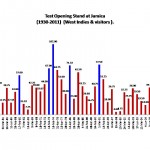
Sabina Park, Jamaica. Average Opening Stand

This gallery contains 1 photo.

More Galleries | Leave a comment

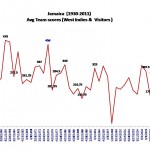
Sabina Park, Jamaica. Avg Test score.

This gallery contains 1 photo.

More Galleries | Leave a comment

Australian Venue

[nggallery id=22].  

More Galleries | Leave a comment

England Venues

[nggallery id=21].

More Galleries | Leave a comment

19 Jun 2011 Last updated at 8:17 amIndicator & Formula (all formats)


A Guide to Indicators & Formulas

Abbreviation & Meaning used in this index

Batting Indicator (Primary)

Abbreviation Indicator
Bat Avg Batting Average
SS Scoring Shots
SS/Balls Scoring rate per 100 balls
SS(singles)% Scoring rate in singles
SS(boundaries)% Scoring rate in Boundaries
B/W Balls per Wicket or Bowling St.Rate
Value %  Batsman scored Runs/Team Avg.
Role % Batsman’s scored Runs/(Team’s End score – Begin score)
Begin Score Team’s score at beginning of a batsman’s Innings
End Score Team’s score at end of a batsman’s Innings


Batting Indicator (Secondary)

Abbreviation Indicator
St. Rate Strike. Rate
4s % % of Boundaries
1s %  % of singles
0s % % dot balls
R/Hr Runs per Hour
“0” Marker(No.of balls to get off the mark)


Bowling Indicator (Primary)

Abbreviation Indicator
Bowl Avg Bowling Average
R/O Runs per Over
B/W Balls per Wicket or Bowling St.Rate
SS Scoring Shots
SS/Balls Scoring  rate per 100 balls
SS(singles)% Scoring rate in singles
SS(boundaries)% Scoring rate in Boundaries
C 4 Consecutive less than 4 runs
L 4 Less than 4 runs per over
L 3 Less than 3 runs per over
C 3 Consecutive less than 3 runs
LER Low Economy Rate
LSR Low Strike Rate
X  Factor LER x LSR

 Note : L3, L 4 – are called as Less than, and CM, C3, C 4 are called as Consecutive 

Bowling Indicator (Secondary)

Abbreviation Indicator
4s % % of Boundaries
1s %  % of singles
0s % % dot balls
NB & W % % of Error Balls(NB & W)
B & LB % % of byes & leg byes
1ball(runs)% % runs scored of 1st ball of an over…look at number of ball bowled and find the average score of each ball. From Batting perspective how many times a teams are able to score from these balls – from Bowling perspective for the same balls how times bowlers and their team have prevented opposition Batsmen from scoring.
2ball(runs)% % runs scored of 2nd ball of an over
5ball(runs)% % runs scored of second last  ball of an over
6ball(runs)% % runs scored of last ball of an over
1ball(wkts)% % wkts on 1st ball of an over
2ball(wkts)%   % wkts on 1st ball of an over
5ball(wkts)% % wkts on 1st ball of an over
6ball(wkts)% % wkts on 1st ball of an over
6+/over % 6 => runs conceded in an over
10+/over % 10 = > runs conceded in an over


The Gap Factor

All teams want to win a cricket match, or at least not lose one.

Batting side(offense) will always want to score more runs in less balls, at same time lose less wickets. On the other hand the bowling side(defense) wants to pick wickets in less balls, and concede less runs.

This reflects their strength and weakness. To find out how they go about it in terms of data/stats/numbers – we deviced something called “The gap factor”.

Its similar to NRR but with only one calculation – minus the batting performance with bowling performance. If the numbers is in plus figure than that team is doing well in that particular indicator, but if the numbers are in minus figure than that team is performing poorly in  that department.

(625)…Impact Points Leverage(IPL)

Cricket (2005-2010)…in nutshell!.

embedded by Embedded Video

More Galleries | Leave a comment

Tests in England (Venuewise & Monthwise )1880-2010–Part II

embedded by Embedded Video

More Galleries | Leave a comment

Tests in England(Venuewise/Monthwise )1880-2010 – Part I

embedded by Embedded Video

More Galleries | Leave a comment

World Cup Champions & their key players.

This gallery contains 10 photos.

As the 12th edition of ICC World Cup begins tomorrow(30th May 2019). Here is a look at average age of 15 member squad of teams participating in this tournament. Interestingly this World Cup has maximum players who are 30 plus. … Continue reading

More Galleries | Leave a comment