So far only 4 Twenty20 Int. has been played in India!!. Instead of “Howzat”, should have used the word “why” ??. Here is a list of T20Is played various countries. Matches played in Test playing countries Country Mts SA 45 … Continue reading
Analysis


So far only 4 Twenty20 Int. has been played in India!!. Instead of “Howzat”, should have used the word “why” ??. Here is a list of T20Is played various countries. Matches played in Test playing countries Country Mts SA 45 … Continue reading
The Story of song “Smoke on the Water” I was shocked to read this column, Zara Hatke(or “kuch bhi”) by Rahul da Cunha in Midday,dated July 22, 2012. A gross mistake!!!. At least the newspaper editor & or the … Continue reading
Marco de Goeij, a Dutch composer. A music genius, as his feat will always be remembered in the history of rock music, as he reworked & completed <Gemini Suite>a rock fusion by John Lord/Deep Purple and conductor Malcolm Arnold, … Continue reading
This article by Natasha Bita for Inquirer in dated April 13-14, 2002, was an eye opener in the world of sports science for me. Back in those days, thanks to Ben Johnson, a Canadian sprinter, I became aware of … Continue reading
This article “Mass plus power equals speed” : in dated dated Aug3-4, 2002, written by Chip Le Grand
This is my best short-read article on sport analysis!
Leading a query…can we have a playground of competition against other species??!.
Few months back was watching this documentary film <Dolphin Tale>based on a book of same name, an inspired true story of Winter, a bottlenose dolphin.
Seemingly, dolphins can only swim if they flap their tail vertically, and if they flap them horizontally, then their spine gets damaged.
Coming back to this article, fascinatingly Australian swimmer Ian Thorpe’s speed is compared to sea creatures and key to his success was his size and his ability to maximize its length in the water.
Experts feel humans generally don’t go fast enough, because they don’t have a proper bow wave, and one of the reason being, the backs of swimmer is inside the water most times, so is middle part of the body.
A bow wave is a term used by the marines. It’s a wave that forms at the bow of a ship while moving through the water.
With swimmers, a bow wave is formed at the head when they move through the water. The channel of this wave lies near the mouth of the swimmer helping them to inhale air.
A perfect swimmer should be looking for “Kelvin-wake”, viz less wave and more speed.
I am wondering if one has to create a perfect bow or a “Wake”, then swimmers should slap splash less water which creates less waves, and focus on maximizing their length of their body, and keeping their backs out of the water(surf board)!.
After watching Shelly-Ann Fraser-Pryce win the Woman’s 100m finals on Saturday 5th Aug at the London Olympics, I was encouraged to post this article.”You think that was fast? It is from The Australian< dated September 21-22(2002) a very interesting article, … Continue reading
My main area of interest has been Sports and Arts. And in years gone by I have collected few articles. Apart from renting, borrowing, buying books, magazines & journals, I was blessed with some great resources.
My my major source of information was libraries, which i religiously attended.
These are the libraries I visited in Mumbai
British Council Library,
Australian Council Library
Max Muller Bhavan
American Library
Alliance De France
Although most material from my collection has been destroyed by white ants. As i found out that it is never easy to take care of paper material in humid condition.
It gives great pleasure to share few of them. A collage of articles on analysis including a phenomena called Andrew Symonds!.
This article” Little old ladies show why small is big in cricket!.
is from <The Australian> newspaper, dated April1, 1999 Thursday.
It was during Australia tour of West Indies in 1999, the best Test series of modern generation. In a 4 match series, West Indies were 0-2 down, after they were humiliated for 51 and defeated by a mountainous 312 in the first 2 Tests.
Then atBridgetown, everything changed…as Mike Coward of <The Australian> wrote ” West Indies did not defeat Australia, it was Lara who overcame Australia by one wicket in a match of such emotional intensity that in the end watchers were as wrung-out as the protagonists.”
He further adds “Men and women who would never cry in public cried openly. Young and old filed on the the scared site that is the Kensington Oval. Some lay prostrate on the pitch and kissed the turf Lara had trodden. Others genuflected in front of the West Indies room and hoped they may get a sighting of the prince of Trinidad and Tobago”.
Mr Coward ends his article with “ Indeed in its own way, it was a performance fit to be ranked with any of the great solos given by Ali, Pele and Jordan during their phenomenal career”
I watched and covered this game, and was moved by Lara’s batting.
They say, Sir Donald Bradman played in a very similar way, but apart from few clips I have not seen Sir Don in full innings.
Hence for me there is no batsmen in past or present who played in such manner. Brian Lara had taken the art of batting to another level. There is none who perfected the vertical, horizontal bat(such high back-lift) so effectively & successfully!.
This article Radio controlled was published on 18th May 1999. Hansie Cronje former deceased South African captain and Allan Donald were ear- pieced with their former deceased coach Bob Woolmer. It was one way radio communication that was immediately interrupted and disallowed by match referee Talat Ali.
Its been more than 13years since this thought was conceived. Now, in today’s “techno-savy world” should this technology be permitted in cricket?.
Perhaps an initial experiment at domestic level, especially in T20 format should make us understand its value to the game, players, officials and even broadcasters!.
This is a original scorecard from Oct 11, 1992, Round 2 of an under-19 Brisbane grade tournament. Gold Coast v/s South Brisbane played at Boundary St 2
Andrew “Roy” Symonds opened the batting with Matthew Mott(now coach/mentor at Glamorgan, played for Queensland between 1994-95 till 1998)
Interestingly Andrew’s adopted father Ken nick named him “Roy” after Roy Race a character from British comic strip’s mythical football team called Melchester Rovers.
On request this scorecard was send to me by Warwick Glaves from Gold Coast. Many thanks to him, as i am able to share this wonderful cricketer’s past achievement.
For the record Gold coast scored 585 -3 of 50 overs!.
Roy Symonds 220 “retired out (99 balls, 27 fours, 14 sixes), and Matthew Mott retired out for 212 (117 balls, 20 fours, 14 sixes) as they put 446 runs for 1st wkt before both retired in the 37th over!.
In reply South Brisbane scored 158-4 of 50 overs.
Cricket loses future stars to AFL cash
Few years(1999) before this article I Remember reading Rod Marsh’s article as an guest columnist<Fine-tuning> for The Observer, UK Then he was Australian under-19 coach which was on a tour to UK. He mentioned that Australia will have a problem around 2008, especially in their batting department, and gave a example of Brad Green whose talent knew no bound and cricket lost this prodigy to AFL.
This gallery contains 1 photo.
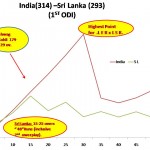
ODI series. India in Sri Lanka – 1st ODI – Analysis in GFX 2nd game, Hambantota. It was during World Cup 1996 that one first saw a score of 300 in Sri Lanka, as the host scored 398 … Continue reading
embedded by Embedded Video
Download Video
In my previous post on T20 I had mentioned opening batsmen score maximum No. of 50+ scores for their team. Here in this analysis have gone further to find contribution made by the top 4 batsmen(including opening pair) in terms of runs scored and balls faced. Its never easy for batsmen to aclimatise themselves to various format as one can observe steep fall in runs scored in this format. Although T20 has benefited players (Batsmen, bowlers and fielders) in promoting themselves to other formats, but as a unit they no team has been dominating effectively for even small period of time. In below table one can clearly see the % of balls faced while scoring those runs by TOP4 batsmen. This figure was far less and much closer to % runs scored. In Australia case its very apparent. In 2009, their top4 batsmen consumed 71% of balls while scoring 62% of team’s score, however now its risen to 83.22%!!.
| Teams | Mts | %Runs by Top4 Batsmen | % of balls faced by Top 4 Batsmen |
| Pakistan | 55 | 58.49% | 63.81% |
| New Zealand | 50 | 62.56% | 65.96% |
| Australia | 49 | 60.56% | 83.22% |
| South Africa | 44 | 65.15% | 67.69% |
| England | 44 | 58.67% | 62.39% |
| Sri Lanka | 40 | 67.06% | 70.54% |
| West Indies | 35 | 62.51% | 66.88% |
| India | 34 | 64.69% | 68.07% |
| Zimbabwe | 20 | 64.36% | 66.73% |
| Bangladesh | 18 | 54.04% | 52.50% |
| Year | Mts | Avg score(1st Bat) | % Win -Chasing Targets |
| 2005 | 3 | 175 | 33.33% |
| 2006 | 12 | 161 | 50.00% |
| 2007 | 50 | 159 | 52.00% |
| 2008 | 79 | 147 | 54.43% |
| 2009 | 127 | 151 | 51.18% |
| 2010 | 198 | 149 | 51.01% |
| 2011 | 216 | 149 | 51.39% |
| 2012 | 246 | 148 | 51.22% |
Progressive stats are updated at end of Pak -SL T20 series (June 2012)
| Teams(Rank) | Mts | Win | Loss | % Win |
| Pakistan(5) | 55 | 33 | 21 | 60.00% |
| South Africa(2) | 44 | 29 | 15 | 65.91% |
| Australia(6) | 49 | 25 | 22 | 51.02% |
| New Zealand(4) | 50 | 24 | 23 | 48.00% |
| Sri Lanka(3) | 40 | 24 | 16 | 60.00% |
| England(1) | 44 | 23 | 19 | 52.27% |
| India(7) | 34 | 17 | 15 | 50.00% |
| West Indies(9) | 35 | 14 | 19 | 40.00% |
| Zimbabwe(12) | 20 | 3 | 16 | 15.00% |
| Bangladesh(no rank) | 18 | 4 | 14 | 22.2% |
Another major reason for team’s inability to score big in last 2 years(since 2010)…
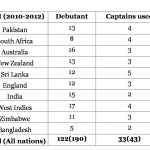
* These debutants had a very little impact as a batsmen. Only 2 batsmen made 50s on their debut.
* There were 43 various captains(11 for associate members) leading their side in this format
* Bowling wise, 8 of them picked three or more wickets on their debut
Above points only suggest that if there is constant change in numbers of personal in a team,l (players and captains) then it disturbs team dynamic and thinking, leading to constant change of strategy and tactics(trying to accommodate different players), which has very less effect on win factor. Although individually players have been performing brilliantly, and most got promoted to ODIs & Test matches, but as a unit all teams have suffered..Cricket being an individual game with team being its frame does not apply in this format, not yet!.
Over-arm bowling Part II video :
Bend elbow: especially while bowling doosra.
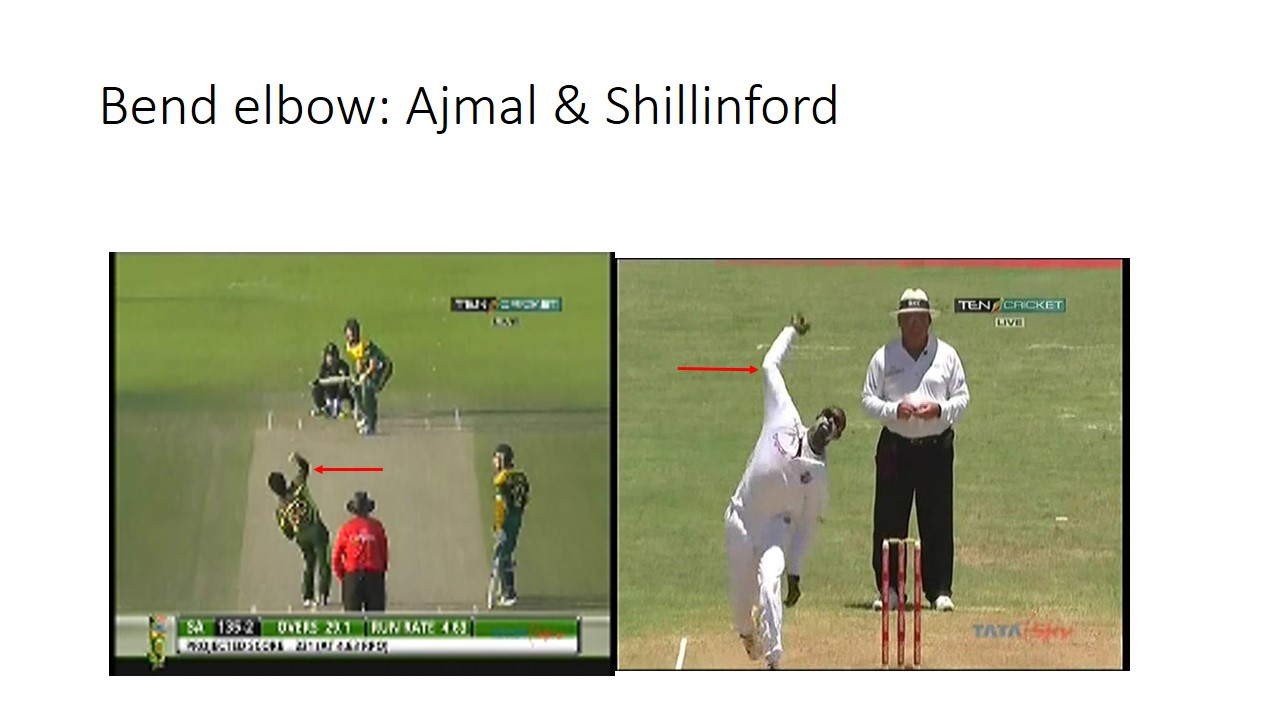
Bend Elbow

embedded by Embedded Video
Over-arm Bowling – unlike batting, this involves 4 skills viz. 2 primary & 2 secondary Primary skills – 1) Length – is the foremost skill one learns as a bowler. 2) Line – of the ball. … Continue reading